
Key Takeaways:
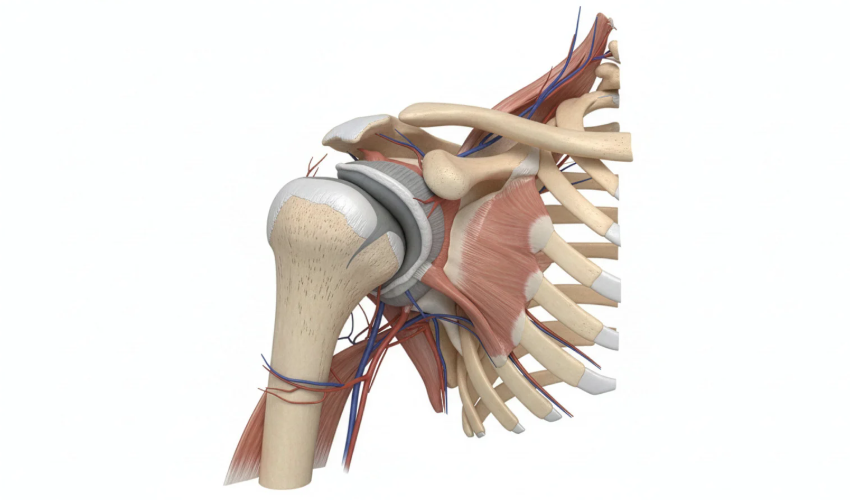
- The shoulder is made of two joints: the glenohumeral joint and the acromioclavicular joint.
- The acromioclavicular joint is where your collarbone connects to your shoulder blade.
- A shoulder adductor test can help identify if shoulder pain originates from the acromioclavicular joint.
If you are feeling pain in your shoulder, your doctor may conduct a shoulder adductor test. Because the shoulder is made up of two joints, the glenohumeral joint and the acromioclavicular joint, this test can help identify which of them may be producing the pain. A shoulder adduction test determines if someone has acromioclavicular pain, or pain at the AC joint.
The shoulder adduction test is very simple:
- The patient will raise their hand and arm 90 degrees in front of themselves.
- A doctor will move it across the chest horizontally, or adduct it.
- If there is pain can be reproduced in the AC joint area, the test is positive.
What is the Acromioclavicular Joint?
The acromioclavicular joint, also known as the AC joint, is one of two joints in the shoulder. It connects the clavicle (collarbone) to the top part of the scapula, called the acromion (Washington University Medicine). When you move your shoulder, the AC joint helps it move from back to front as a planar joint, or a joint that lets two bones glide past each other.
Its primary job is to support your shoulder and act as a connection point for the surrounding ligaments. It is a passive joint, so it does not move by itself. Any movement of the AC joint is performed by the muscles, tendons, ligaments, and the other joints. The AC joint includes the following components:
- Collarbone
- Shoulder blade
- Cartilage
- Nerves
- Blood vessels
- Acromioclavicular ligament
- Coracoclavicular ligament, made up of the trapezoid and conoid ligaments
Most Common Ways the AC Joint is Injured
The AC joint is susceptible to injury from both the shoulder and the collarbone. Stretched, strained, or torn ligaments are possible, especially with acute shoulder trauma associated with (Mass General Brigham):
- Falling directly on the shoulder
- Sustaining a hard hit to the shoulder
- Lifting heavy objects
Arthritis can also develop if the cartilage sustains damage or wear-and-tear. The most common sport injuries for AC joints are heavy-hitting sports like American football, martial arts, hockey, skiing, snowboarding, and biking.
Degrees of Injury to the AC Joint
There are 6 classifications for injury to the AC joint and its ligaments (National Library of Medicine, Acromioclavicular joint injuries: diagnosis, classification and ligamentoplasty procedures):
- Type I is a sprain injury of the AC ligament. There is no complete tear and both AC and CC ligaments are intact.
- Type II is a tear of the AC ligament but not of the CC ligaments.
- Type III involves tears of both the AC and CC ligaments, with 25% to 100% displacement of the clavicle compared with that on the contralateral side.
- Type IV is when both the AC and CC ligaments are torn and there is posterior displacement of the distal clavicle into the trapezius fascia.
- Type V involves the AC and CC ligaments and both the origin of the deltoid and insertion of the trapezius tearing, causing extreme instability of the AC joint. It is a complex injury where the deltotrapezial fascia is stripped from its attachment and displacement of the clavicle is more than three times the diameter of its distal part. The CC distance is increased to 100% to 300%.
- Type VI injuries are the result of inferior displacement of the distal clavicle into the subcoracoid position.
Frequently Asked Questions About the AC Joint and Shoulder Adduction Tests:
- How accurate is the shoulder adduction test?
- A shoulder adduction test is a non-invasive tool that people can use to help get a sense of where pain is coming from. It is not meant to formally diagnose any specific condition, so accuracy depends mostly on pinpointing the origin point of pain and then taking the correct steps.
- What should you do if a shoulder adduction test causes pain?
- If you perform a shoulder adduction test and find that you have pain at or around the AC joint, the next steps would be to identify how much pain you are in and make a decision to see a doctor or treat the symptoms yourself. However, if treating your AC joint pain with OTC pain medications, ice, and rest does not help within a few days, see a doctor.
- What AC joint conditions does a positive shoulder adduction test implicate?
- A positive shoulder adduction test does not implicate a specific condition. However, common injuries and conditions that may cause your test to be positive include arthritis, sprains, torn ligaments, or a dislocated joint.
If you or someone you love has suffered an AC joint injury in the Louisville, Kentucky-area, board certified sports medicine physician Dr. Stacie Grossfeld at Orthopaedic Specialists PLLC can help. Orthopaedic Specialists PLLC is accepting new patients, and same day appointments are available. For additional information or to schedule an appointment, please contact Orthopaedic Specialists PLLC today at 502-212-2663.
Recent Comments