Patient of the Month: Joyce Koch

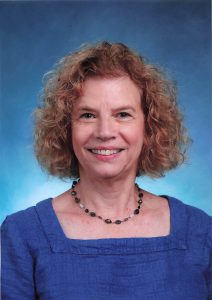
Meet this month’s patient in the spotlight, Joyce Koch!

Joyce Koch suffered from arthritis in her knees, which Dr. Stacie Grossfeld at Orthopedic Specialists in Louisville, KY was originally treating her for, when she was rear-ended twice and needed physical therapy for back pain.

If you were previously a student at St. Agnes, Assumption High School, or Presentation Academy, then Joyce’s name might be familiar. Having been a teacher since 1968, with 29 years spent at Assumption High School and the other 24 spent between Presentation Academy and St. Agnes teaching English and math, Joyce has had a long career in the Louisville educational field.

What makes Joyce a true spotlight patient, though, is that she sought opportunities to become better and initiated changes in her community that benefited the students she taught, the teachers she worked alongside, and her school as a whole.

When mainstream technology and computers became popular in the early 80’s, Joyce saw it as an opportunity to grow and took it, obtaining a degree in computer education at Spalding University along with her higher education degrees she already had in other areas. This led her to become first the technology coordinator at Assumption, and then the IT Director 9 years later, where she led the school in becoming leaders in educational technology for 20 years.

Joyce Koch was a teacher at Assumption High School, Presentation Academy, and St. Agnes before she was injured in a car accident and needed physical therapy in Louisville from Dr. Grossfeld at Orthopaedic Specialists.

Now retired since 2021, Joyce would have liked to have spent her last few years working as she always had: with pep, passion and without any pain. For much of her life, Joyce was able to enjoy being a mother, teaching, reading, yoga, stretching, and walking for miles without any difficulties. In fact, she belongs to 2 different book clubs, listens to audiobooks regularly, and lives her life with the motto that, “You always have time for the things you put first,” – something that she always managed to apply to her stretching routine! She loves walking through Louisville’s myriad of beautiful parks, and was even in the habit of walking the mile from her home to school every day when she was working at Assumption High School.

Her time doing what she loved was cut short unexpectedly, though, when she experienced a series of injuries that put her out of commission in 2019.

Joyce’s Story

One After Another

Before her recent injuries, Joyce’s relationship with Dr. Grossfeld and Orthopaedic Specialists dates back to 2005, when an instructional yoga video with her daughters triggered an arthritis flair-up in her right knee. This particular injury didn’t seem all that serious – when Dr. Grossfeld headed her PT, her pain went away and she had no complications until 2019, when her other knee began giving out on her. Deciding to take her issue to Dr. Grossfeld again, she made an appointment, but before she was able to address her knee, she was rear-ended in a car accident and began experiencing back pain that was much worse than her knee pain.

Dr. Grossfeld was able to address her pain and injuries with medications and another bout of physical therapy, this time for her back, but before she experienced relief, less than a month from her accident, Joyce was rear-ended again, which worsened her condition to the point that standing and walking caused her severe pain. Now using a cane and having difficulties sleeping that also led to a pop-up case of temporomandibular disorder (TMD), Joyce felt it was time to take a leave of absence so that she could focus on resolving her pain. Dr. Grossfeld was able to send her to a pain specialist, who diagnosed a pinched nerve in her vertebrae that would require a series of treatments over the course of a few weeks.

But, in the midst of her pain, the world was hit by the pandemic and Joyce’s pain center closed, leaving her without treatment until June of 2020. Even struggling with pain, Joyce managed to contribute to Assumption’s success during the age of online learning before her injury ever happened – she’d had the foresight to begin teaching the teachers about online instruction and how to navigate that world a whole year before, and her colleagues and students had never been more grateful, even as she was on leave.

By the time she was able to receive treatment, Joyce’s back pain had caused her knees to worsen without the ability to walk or keep stretching, which led to her right knee replacement in 2021. But, as her right knee improved, Joyce found that her left knee’s development was moving in the opposite direction. Sure enough, Dr. Grossfeld completed a knee arthroscopy surgery to remove a meniscal tear in her left knee, which fixed her pain until her arthritis came back and she was sent to get her left knee replaced.

Recovery and Joyce Today

From her original concerns until her last knee replacement surgery, Joyce says that her recovery took around a total of 3 years. At the height of her pain, Joyce felt unable to do most things that she loved, including walking, stretching, and even cooking! While she tried to supplement some parts, like taking up water-walking at Dr. Grossfeld’s advice, the lack of sleep and weakness her injuries caused left her mood suffering.

These factors combined with the effects of the pandemic caused her retirement to come earlier than she intended, but it allowed her to put 100% into getting better and back to a quality of life that was as close to where she was before as possible.

Joyce Koch was the IT Director at Assumption High School and a leader in educational technology. When she was rear-ended and injured her back, Dr. Grossfeld at Orthopaedic Specialists in Louisville gave her the diagnoses and physical therapy she needed to recover.

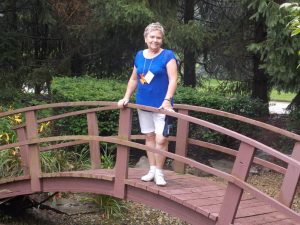
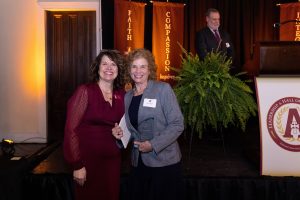
(Pictured Above: Mary Lang, President of Assumption High School, and Joyce Koch on March 22, 2023, when she was awarded a “Distinguished Educator” trophy and an honorary diploma.)

“Dr. Grossfeld truly listens to what you are feeling and hones in on the correct plan of action. She and her staff are caring, compassionate people treating the whole person, not simply one offending joint. I have recommended them to my family and friends who feel the same way about them as I,” Joyce says, having done plenty of physical therapy and treatments with Dr. Grossfeld throughout the time she was injured and recovering.

With the help of Dr. Grossfeld’s diagnoses and recovery methods, now, with the back pain under control and both knees replaced, Joyce is back to stretching first thing in the morning for 20-30 minutes to start her day and is able to walk 3 or 4 miles a day as she had before. Sleeping through the night and the ability to cook homemade meals every night once more has become normal, and Joyce says that the work was difficult in many ways, but that she’s grateful to be back to doing what she loves!

If you or someone you love has suffered a knee or back injury in the Louisville, Kentucky-area, board certified sports medicine physician Dr. Stacie Grossfeld at Orthopaedic Specialists PLLC can help. Orthopaedic Specialists PLLC is accepting new patients, and same day appointments are available. For additional information or to schedule an appointment, please contact Orthopaedic Specialists PLLC today at 502-212-2663.

Educación del paciente: Reparación del codo de tenista

Descripción General de la Reparación del Codo de Tenista
Especialistas Ortopédicos 502-212-2663
Stacie Grossfeld, M.D. / Bess Fley, PA-C

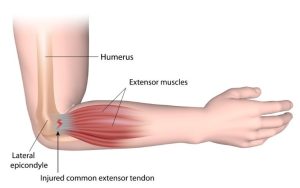
La cirugía de codo de tenista se realiza como un procedimiento ambulatorio.

A su llegada al centro quirúrgico, primero se reunirá con la persona de registro para registrarlo. Luego lo llevarán de regreso al área preoperatoria y se reunirá con su equipo de enfermería.

Anestesia

La siguiente persona que conocerá es el médico de anestesia. En este momento, el anestesiólogo discutirá el proceso y abordará cualquier pregunta o inquietud que tenga sobre la anestesia. El anestesiólogo puede colocar un bloqueo nervioso para adormecer su brazo o el Dr. Grossfeld puede inyectar un anestésico local al final del procedimiento.

Usted irá al quirófano donde se realiza la cirugía. Luego, el anestesiólogo administrará una anestesia general, por lo que estará completamente dormido para el procedimiento. Debido a que es una anestesia general, no escuchará ni verá nada de lo que sucede en la sala de operaciones.

Procedimiento quirúrgico

Una visión general de la cirugía de reparación del codo de tenista con el Dr. Grossfeld.

El Dr. Grossfeld luego realizará la cirugía de codo de tenista. Este procedimiento dura entre 30-40 minutos. Tenga en cuenta que después de regresar a la sala de operaciones, toma entre 40 y 60 minutos irse a dormir y colocarse en la cama de la sala de operaciones, por lo que es posible que su familia no lo vea durante 1.5 a 2 horas, dependiendo de qué tan extenso sea el procedimiento quirúrgico y qué deba solucionarse.

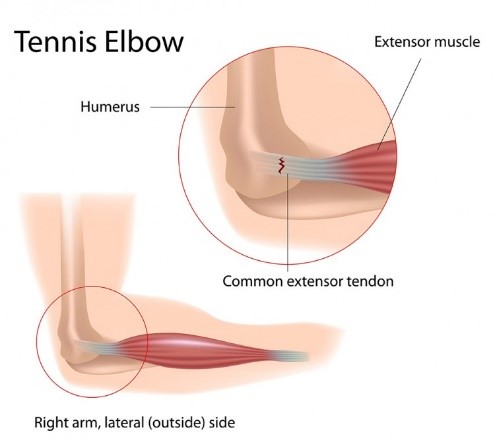
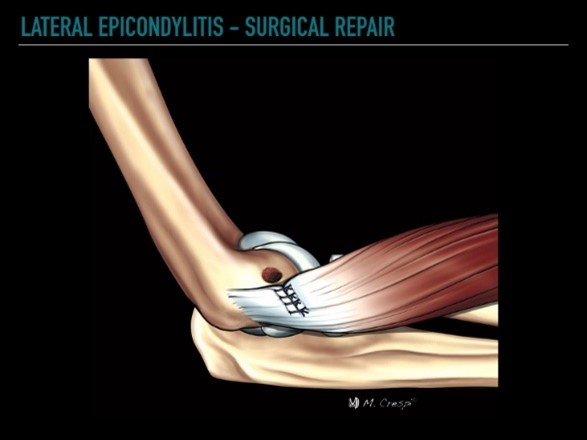
El Dr. Grossfeld hará una incisión alrededor de la articulación del codo. Ella desbridará cualquier tendón no saludable y reparará el tendón desgarrado.

Los anclajes de sutura están hechos de un hueso sintético, por lo que los anclajes se incorporarán realmente a su propio hueso. Los anclajes de sutura se colocan en el hueso que luego “ancla la sutura” y esas suturas se cosen a través del tendón extensor común para reparar el tendón dañado. La incisión se cierra con 2 capas de suturas que son solubles. Habrá tiras blancas estériles que también se utilizan para ayudar a cerrar el sitio de la incisión.

Al salir de la sala de operaciones, se le colocará una gasa de 4 x 4 sobre los sitios de incisión, seguida de almohadillas ABD, que son un apósito esponjoso más grande, seguido de un relleno de yeso. Luego se aplicará una férula de yeso para que no pueda doblar el codo o la muñeca. En su primera visita postoperatoria, se retirará la férula y se le colocará un aparato ortopédico para el codo que permita un poco de movimiento del codo. También se le colocará una férula para la muñeca para limitar el movimiento de la muñeca.

Una visión general de la cirugía de reparación del codo de tenista con el Dr. Grossfeld.

Noche de Cirugía

Es muy importante que te mantengas al tanto del dolor.

Ella recomienda que configure su despertador y tome su medicamento para el dolor cada 4 a 6 horas durante las primeras 24 horas para mantenerse al tanto de su dolor. Agregar 800 mg de Motrin cada 6 horas o Meloxicam 15 mg cada 24 horas puede ayudar a controlar el dolor. No use Motrin o Meloxicam si está tomando anticoagulantes o tiene antecedentes de úlceras estomacales o enfermedad renal.

Primera visita postoperatoria

Su primera visita postoperatoria será de 10 a 14 días después de la cirugía. Usted será visto en la oficina en ese momento y le quitarán los extremos de las suturas. El Dr. Grossfeld o Bess Fley, PA-C responderán cualquier otra pregunta.

Fisioterapia

La fisioterapia no se iniciará hasta la semana 6-7 después de la cirugía después de que se suspendan los frenillos. Esto es aproximadamente una recuperación de tres a cuatro meses antes de que vuelva a sus actividades normales que involucran el codo operatorio.

Conducción

La mayoría de las personas comenzarán a conducir una vez que hayan dejado de tomar todos los analgésicos y se haya retirado la férula en la primera visita postoperatoria: 10-14 días después de la cirugía.

Regreso al trabajo

Si trabaja en un trabajo de tipo laboral, lo más probable es que no regrese a ese trabajo hasta que sea liberado al 100%. Esto podría ser de 3 a 4 meses dependiendo de la descripción de su trabajo.
Si su empleador tiene opciones de trabajo ligero, lo más probable es que sea liberado en cualquier lugar entre dos y cuatro semanas de regreso al trabajo liviano, y generalmente el servicio liviano no requerirá el uso del lado quirúrgico / el lado en el que se realiza su cirugía, excepto para tareas simples como usar una computadora o contestar un teléfono.

Si tiene un trabajo de oficina, lo más probable es que pueda volver a trabajar entre una y cuatro semanas. El regreso al trabajo también dependía del nivel de dolor y la descripción del trabajo. Algunas personas tienen mucho dolor después de esta cirugía en particular, algunas personas tienen muy poco. El dolor es muy personal y diferente de persona a persona.

FMLA y papeleo de discapacidad

Nuestra oficina ofrece el servicio de completar el papeleo para FMLA y / o discapacidad por una tarifa de $ 40, por conjunto de documentos, y se completa en el orden en que se recibe, generalmente toma de 7 a 10 días hábiles. Todas las solicitudes deben originarse con su empleador, ya que su elegibilidad para FMLA y / o discapacidad se basa en sus beneficios con su empleador. Si bien cada paciente es único, hacemos todo lo posible para estimar el tiempo de recuperación y, a menudo, sobreestimamos la cantidad de tiempo para evitar un lapso en los beneficios y / o requerir papeleo adicional. Muchas veces las compañías de discapacidad requieren actualizaciones después de cada cita. Es responsabilidad del paciente comunicar esta solicitud a la oficina. Las actualizaciones no se completan automáticamente. Cualquier pregunta al respecto puede dirigirse a Dorothy.

Patient Education: Tennis Elbow Repair

Tennis Elbow Repair Overview
Orthopaedic Specialists 502-212-2663
Stacie Grossfeld, M.D. / Bess Fley, PA-C

Tennis Elbow surgery is performed as an outpatient procedure. Upon arrival at the surgicenter you will first meet with the registration person to check you in. You will then be brought back to the pre-op area and meet with your nursing team.

A step-by-step guide of the tennis elbow repair surgery with Dr. Grossfeld in Louisville, KY.

Anesthesia

The next person you will meet is the anesthesia doctor. At this time the anesthesiologist will discuss the process and address any questions or concerns you have about the anesthesia. The anesthesiologist may place a nerve block to numb up your arm or Dr. Grossfeld may inject a local anesthetic at the end of the procedure.

You will go to the operating room where the surgery is performed. The anesthesiologist will then administer a general anesthesia, so you are completely asleep for the procedure. Because it is a general anesthesia you will not hear or see anything going on in the operating room.

Surgical Procedure

Dr. Grossfeld will then perform the tennis elbow surgery. This procedure takes between 30-40 minutes. Keep in mind after you head back to the operating room it takes about 40-60 minutes to go to sleep and get positioned on the operating room bed so your family may not see you for 1.5 to 2 hours depending on how extensive the surgical procedure is and what needs to be fixed.

Dr. Grossfeld will make one incision around the elbow joint. She will debride any unhealthy tendon and repair the torn tendon.

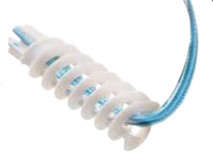
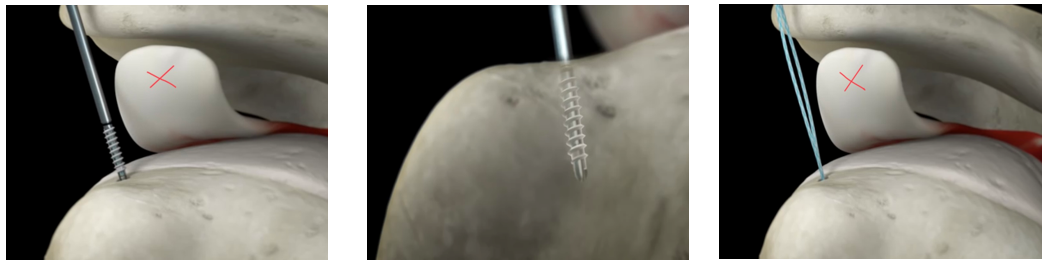
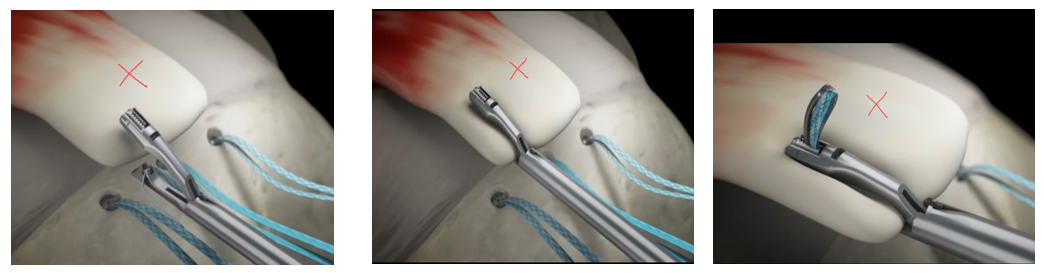
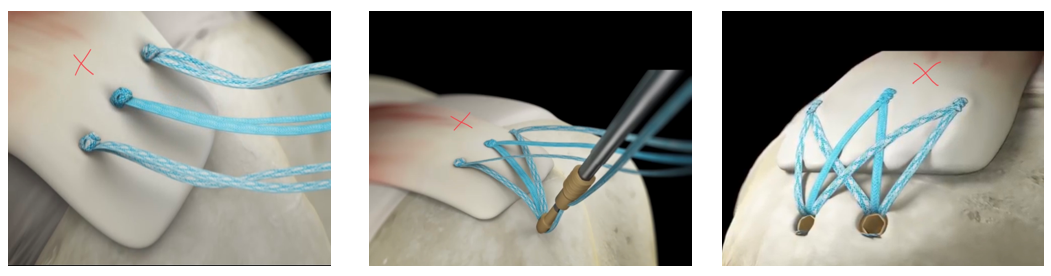
The suture anchors are made out of a synthetic bone so the anchors will actually incorporate into your own bone. The suture anchors are placed into the bone which then “anchors the suture” and those sutures are then sewn through the common extensor tendon to repair the damaged tendon. The incision is closed with 2 layers of sutures that are dissolvable. There will be white sterile strips that are also used to help close the incision site.

Upon leaving the operating room, you will have 4 x 4 gauze placed over the incision sites, followed by ABD pads, which are a larger fluffy dressing, followed by cast padding. A plaster splint will then be applied so you are unable to bend your elbow or wrist. At your first post operative visit the splint will be removed and you will be placed into an elbow brace that allows some elbow motion. You will also be placed in a wrist splint to limit wrist motion.

An overview to tennis elbow repair surgery with Dr. Grossfeld.

Night of Surgery

It is very important that you stay on top of the pain.

She recommends that you set your alarm clock and take your pain medication every 4 to 6 hours for the first 24 hours to stay on top of your pain. Adding 800 mg Motrin every 6 hours or Meloxicam 15 mg every 24 hours can help control pain. Do not use either Motrin or Meloxicam if you are on blood thinners or have a history of stomach ulcers or kidney disease.

First Post-Operative Visit

Your first post operative visit will be 10-14 days post-surgery. You will be seen in the office at that time and have the ends of the sutures removed. Dr Grossfeld or Bess Fley, PA-C will answer any other questions.

Physical Therapy

PT will not be started until your 6-7th week after surgery after the braces are discontinued. This is about a three to four month recovery before you are back to your normal activities involving the operative elbow.

Driving

Most people will start driving once they are off all pain medication and the splint has been removed at the first post operative visit: 10-14 days after surgery.

Return to Work

If you work a labor type job, you will most likely not return back to that job until you are released 100%. This could be 3-4 months depending on your job description.

If your employer has light duty options, you will most likely be released anywhere between two to four weeks back to light duty, and typically light duty will not require the use of the surgical side/the side your surgery is performed on, except for simple tasks such as using a computer or answering a phone.

If you have an office type job, you can most likely get back to work between one to four weeks. Return to work also depended on pain level and job description. Some people have a lot of pain after this particular surgery, some people have very little. Pain is very personal and different from person to person.

FMLA and Disability Paperwork

Our office offers the service of completing paperwork for FMLA and/or disability for a fee of $40, per set of paperwork, and is completed in the order that it is received, typically takes 7-10 business days. All requests must originate with your employer, as your eligibility for FMLA and/or disability is based on your benefits with your employer. While each patient is unique, we do our best to estimate the time of recovery and often times over-estimate the amount of time to prevent a lapse in benefits and/or require additional paperwork. Often times disability companies require updates after each appointment. It is the patient’s responsibility to communicate this request with the office. Updates are not automatically completed. Any questions regarding this can be directed to Dorothy.

An April Newsletter From the Desk of Bess Fley, PA-C

Sports Medicine in Louisville, KY, Orthopaedic Specialists, Bess Fley PA-C, Dr. Stacie Grossfeld Supervising Doctor

What is a PA?

PA is an abbreviation for ‘physician assistant,’ which has been recently changed to ‘physician associate.’ According to the American Academy of Physician Assistants, “a PA is a licensed clinician who practices medicine in every specialty and setting.” This can include:

  • Diagnosing and treating medical conditions
  • Prescribing medications and therapy
  • Assisting in surgery
  • Performing procedures in the office or hospital settings

PAs require direct supervision by a supervising physician – Dr. Grossfeld is my supervising physician! We have a very close working relationship and collaborate daily for our patients’ best interest.

What Do I Do with Dr. Grossfeld?

I see patients in the office on a daily basis and regularly perform a physical exam, obtain any imaging studies, and determine a treatment plan for patients based on my findings. Treatment plans differ for every patient, but for my cases, I commonly prescribe anti-inflammatory medications, apply casts and splints, order labs and imaging, write prescriptions for physical therapy, give cortisone or hyaluronic acid injections, and assist in surgery!

How Can You Become a PA?

PAs must first complete a four-year bachelor’s degree at a university. There are many pre-requisite courses required prior to acceptance into PA school. These include, but are not limited to:

  • General chemistry
  • Organic chemistry
  • Psychology
  • Multiple biology courses
  • Anatomy
  • Physiology
  • Statistics

Patient contact hours, shadowing hours, recommendation letters, and scoring in the 50th percentiles on the GRE are additional requirements, too! PA school is 2.5-3 years long, comprised of one year spent completing a classroom learning and skills lab while the remainder is spent in clinical rotations of all specialties. Finally, you then must pass the national licensure exam – the PANCE – which is comprised of 300 questions about any and all disease states.

If you have any questions for me about what I do here at Orthopaedic Specialists, don’t hesitate to reach out and contact me at our office number (502) 212-2663!

If you or someone you love has suffered an injury in the Louisville, Kentucky-area, Orthopaedic Specialists, PLLC can help! Orthopaedic Specialists PLLC is accepting new patients, and same day appointments are available. For additional information or to schedule an appointment, please contact Orthopaedic Specialists PLLC today at 502-212-2663.

Sleeping Tips for Post-Operative Pain

When sleeping is hard with pain after surgery, here are some tips from Stacie Grossfeld, orthopedic surgeon in louisville, KY

When faced with an issue on our phones, laptops, or other various technological devices, oftentimes we know that by turning it off and then on again will reset the device, and things will begin working normally again. A good night’s sleep can sometimes do the same for humans! You go to sleep with a stomachache, or maybe you have a headache, or sore throat, and you wake up feeling just fine – a nice 8 hours seems to fix it better than any medicine would.

Sleep is obviously not the cure-all for every condition, but it is a critical factor in the body’s natural healing process. Proper sleep allows the body to heal in plenty of different ways, but specifically, it:

  • Prompts your immune system to activate the release of a type of small proteins called ‘cytokines,’ which fight inflammation, infection, and trauma
  • Allows you heart to take a break by dropping blood pressure, slowing breath, and relaxing the muscles of the body, which reduces inflammation
  • Replenishes your body’s energy and balances the hormones that contribute to hunger and stress
  • Slows brain activity, which can lead to a more productive attitude and positive feelings

When we’re in physical pain, though, as the result of a surgery, injury, or operation, it can be difficult to find a good night’s sleep in the cards. Especially if your injury affects your normal sleeping position, you might have a hard time catching your Z’s.

Here’s a few tips for sleeping with post-op pain, as well as the best sleeping positions for 4 common operations that Dr. Stacie Grossfeld, Orthopaedic Surgeon and Sports Medicine Specialist, helps rehabilitate.

General Post-Op Pain Sleeping Tips:

  • Practice Your Sleep

If you know you’ll be having an operation in the near future that will affect a part of your body for an extended period of time, practice your sleeping! An abrupt change in position might contribute to restlessness and, when combined with new pain, can be unmanageable. If you start shifting your position and sleeping differently before the pain is introduced, you’ll have a better chance at getting more sleep.

  • Take Pain Medications Strategically Before Bed

Pain medications differ in many ways, from potency, contents, time it takes to be effective, and the time it stays effective. Talk to your doctor beforehand about the medications you’ll be prescribed and get the scoop on side effects and if there are stipulations to when you can take them, because you’ll want that relief to help lull your body to sleep. This can be an important tool in your pain-fighting toolbox, so get your information from the source!

  • Establish a Strong Internal Clock

Waking up and going to bed at the same time everyday isn’t always the most glamorous nor the most convenient, but it helps a lot in the long run. Not only with pain! Having a consistent schedule leads to more, higher-quality sleep year-round, and that has proven to help you:

  • Get sick less often
  • Stay at a healthy weight
  • Lower your risk for serious health problems, like diabetes and heart disease
  • Reduce stress and improve your mood
  • Think more clearly and do better in school/at work
  • Get along better with people
  • Make better decisions to avoid injuries

The Best Sleeping Position for…

1. Knee Surgery and Knee Arthroscopy

For the best healing results after knee surgery, sleep on your back with your leg propped up and straight. However, DO NOT place the propping pillows directly under the knee, as this bends the knee slightly – instead, place them under your calf or foot so that the knee remains completely straight while elevated.

Most doctors don’t recommend sleeping on your side until further along in your treatment and healing, but side sleeping may be more comfortable for some and, with the right support, completely fine, as well. On some procedures, it’s better to wait for side sleeping until your doctor gives the green light, but it’s always important to keep a couple of pillows between your legs to keep your knee up.

2. Shoulder Surgery and Rotator Cuff Surgery

For any shoulder surgeries, including rotator cuff surgery, sleeping with an incline is the most recommended position. Whether this is on a recliner, with a wedge, or with a simple pillow-pile, an incline prevents you from rolling to your healing shoulder. This is a risk that sleeping on your non-operative side or back presents, and that cuts off the proper blood flow and put tension and pressure on the injury, potentially re-injuring it or slowing the healing process down.

If you or someone you love has suffered an injury and have undergone surgery for it in the Louisville, Kentucky-area, board certified sports medicine physician Dr. Stacie Grossfeld at Orthopaedic Specialists PLLC can help with your recovery. Orthopaedic Specialists PLLC is accepting new patients, and same day appointments are available. For additional information or to schedule an appointment, please contact Orthopaedic Specialists PLLC today at 502-212-2663.

Educación del paciente: Cirugía Labral /SLAP/Bankart

Descripción General de la Cirugía Labral / SLAP / Bankart
Especialistas Ortopédicos 502-212-2663
Stacie Grossfeld, M.D. / Bess Fley, PA-C

Una descripción general de las reparaciones de Labral, Bankart y SLAP.

La reparación del labrum, reparación SLAP, y la cirugía de reconstrucción de Bankart se realizan como un procedimiento ambulatorio.

A su llegada al centro quirúrgico, primero se reunirá con la persona de registro para registrarlo. Luego lo llevarán de regreso al área preoperatoria y se reunirá con su equipo de enfermería.

Anestesia

La siguiente persona que conocerá es el médico de anestesia. En este momento, el anestesiólogo discutirá el proceso y abordará cualquier pregunta o inquietud que tenga sobre la anestesia. El anestesiólogo colocará un bloqueo nervioso para adormecer el hombro y el brazo. El medicamento anestésico durará 18 horas. Esta es una excelente manera de reducir el dolor postoperatorio. Incluso después de que el bloqueo nervioso desaparece, su nivel de dolor se reduce debido al efecto antidolor del bloqueo nervioso.

Después de colocar el bloqueo nervioso, usted irá a la sala de operaciones donde se realiza la reparación del labrum, la reparación SLAP y la cirugía de reconstrucción de Bankart. Luego, el anestesiólogo administrará una anestesia general, por lo que estará completamente dormido para el procedimiento. Usted puede ser intubado o no. Hay múltiples factores que determinan el tipo de anestesia. Su anestesiólogo discutirá eso con usted en detalle. Debido a que es una anestesia general, no escuchará ni verá nada de lo que sucede en la sala de operaciones.

Procedimiento quirúrgico

El Dr. Grossfeld realizará la reparación del labrum, SLAP, y Bankart artroscópicamente. Este procedimiento dura entre 45-60 minutos. Tenga en cuenta que después de regresar a la sala de operaciones, toma alrededor de 40-50 minutos irse a dormir y colocarse en la cama de la sala de operaciones, por lo que es posible que su familia no lo vea durante 2.5 horas, dependiendo de qué tan extenso sea el procedimiento quirúrgico y qué deba solucionarse.

El Dr. Grossfeld hará de tres a cuatro incisiones pequeñas, que tienen menos de un centímetro de largo alrededor de la articulación del hombro. Ella colocará una pequeña cámara de alta definición, aproximadamente del tamaño de un lápiz, en la articulación del hombro. Después de insertar la cámara, se completa la inspección de toda la articulación del hombro. Se ve cada compartimento del hombro. Ella identificará dónde se encuentra el desgarro del labrum, SLAP, y Bankart. La reparación del labral/SLAP/Bankart se realiza colocando dos o más anclajes de sutura.

Los anclajes de sutura están hechos de un material óseo de tipo sintético, por lo que los anclajes se incorporarán realmente a su propio hueso. Unidos a la cabeza del anclaje de sutura están los puntos que se utilizan para reparar el labrum desgarrado. Los anclajes de sutura se colocan en el hueso que luego “ancla la sutura” y las suturas se cosen alrededor del labrum desgarrado. Los nudos se atan tirando del labrum desgarrado hacia el hueso donde estaba unido antes de que ocurriera el desgarro.

Si hay espolones óseos, se eliminarán con una pequeña herramienta que es similar a una herramienta Dremel. Si se extirpan los espolones óseos, el procedimiento se denomina descompresión subacromial y/o escisión de la articulación AC.

Al final de la cirugía, el sitio de la incisión/sitios portales se cierran con una sutura de color azul llamada Prolene. Las suturas se retirarán cuando lo vean en el consultorio entre 10 y 14 días después de la cirugía. No deje que las suturas o el sitio de la incisión se mojen. Puede limpiar los sitios de incisión con peróxido. Usted recibió instrucciones postoperatorias detalladas el día de la cirugía que explicarán el cuidado postoperatorio de la herida.

Al salir de la sala de operaciones, se le colocará una gasa de 4 x 4 sobre los sitios de incisión, seguida de almohadillas ABD, que son un apósito esponjoso más grande, seguido de cinta quirúrgica. Su cabestrillo de hombro especializado se colocará en la sala de operaciones.

Recibirá un conjunto detallado de instrucciones sobre el cuidado de la herida al ser dado de alta del centro quirúrgico.

Noche de Cirugía

Es muy importante que te mantengas al tanto del dolor. El hielo es clave. Es muy importante usar hielo tanto como sea posible. El Dr. Grossfeld recomienda el uso continuo de hielo durante todo el día. La regla es que no puedes usar demasiado hielo. Ya sea una unidad Polar Care, una bolsa de hielo o una bolsa de guisantes o maíz congelados: úselo continuamente durante 6-7 días después de la cirugía.

Tenemos una unidad Polar Care que se puede comprar a través de nuestra oficina. Básicamente es una máquina de hielo motorizada que tiene una envoltura de neopreno que se coloca sobre el hombro operatorio. Es un refrigerador que está lleno de hielo y agua. Sugerimos congelar 8 botellas de agua llenas de agua. Coloque cuatro de las botellas congeladas en la máquina y luego vierta agua alrededor de las botellas congeladas. Cuando las botellas se descongelen, cámbielas por las otras cuatro botellas de agua congelada que están en su congelador.

La unidad Polar Care tiene una manguera que se conecta a una envoltura de neopreno que rodea el hombro y empujará el agua helada a través de la envoltura de neopreno durante un máximo de nueve horas. De hecho, le recomendamos que use hielo durante todo el día. Es la mejor fuente de control del dolor y ayuda a reducir la hinchazón.

Ella recomienda que configure su despertador y tome su medicamento para el dolor cada 4 a 6 horas durante las primeras 24 horas para mantenerse al tanto de su dolor. Agregar 800 mg de Motrin cada 6 horas o Meloxicam 15 mg cada 24 horas puede ayudar a controlar el dolor. No use Motrin o Meloxicam si está tomando anticoagulantes o tiene antecedentes de úlceras estomacales o enfermedad renal.

Puede ser más cómodo dormir en posición semi vertical. Dormir en un sillón reclinable o usar muchas almohadas para apoyar el hombro será más cómodo. Algunas personas dormirán en un sillón reclinable hasta 4 semanas después de la reparación del labrum / reparación SLAP / y la cirugía de reconstrucción Bankart. Cuando está acostado en la cama, permite que su hombro ruede hacia atrás y tira de la reparación, lo que puede causar dolor.

Uso de cabestrillo

Usted se despertará en la sala de recuperación con el cabestrillo en su lugar. Puede quitarse el cabestrillo siempre y cuando coloque el brazo contra el abdomen. El Dr. Grossfeld recomienda que duerma en el cabestrillo porque evitará que su brazo se mueva durante la noche.

Apósito quirúrgico

Al final de la cirugía, el Dr. Grossfeld, se pondrá un vendaje. El apósito es un montón de almohadillas de gasa 4×4, una almohadilla abd y luego una cinta quirúrgica especial va encima del apósito.

Consulte sus órdenes postoperatorias que recibirá el día de la cirugía para conocer los detalles del cambio de vendaje.

Los apósitos para comprar antes del día de su cirugía son: de diez a 15: almohadillas de gasa 4×4, cinta médica de papel, tiritas a prueba de agua y peróxido.

Primera visita postoperatoria

Su primera visita postoperatoria será de 10 a 14 días después de la cirugía. Usted será visto en la oficina en ese momento y le quitarán las suturas. El Dr. Grossfeld o Bess Fley, PA-C revisarán sus fotos quirúrgicas y responderán cualquier pregunta. En esta visita lo más probable es que se ordene fisioterapia. Por lo general, la fisioterapia es solo una o dos veces por semana durante las primeras seis semanas. El TP variará de persona a persona según el tamaño del desgarro y la calidad de la reparación.

Fisioterapia

Se le darán ejercicios para hacer post operatorio. Hay un enlace en sus instrucciones / órdenes postoperatorias que recibirá el día de su reparación del labrum, reparación SLAP y cirugía de reconstrucción Bankart. El enlace le mostrará cómo hacer algunos ejercicios postoperatorios suaves. En la primera visita postoperatoria, también deberá comprar un juego de poleas (puede comprar en nuestra oficina por $ 20) para permitirle trabajar en ejercicios de rango de movimiento pasivo en casa.

PT se divide en dos o tres bloques de 6 semanas, dependiendo de qué tan extensa sea la reparación.

Las primeras 6 semanas asistirás una o dos veces por semana para trabajar en ejercicios suaves de ROM pasiva.

Las segundas seis semanas, la terapia implica un rango activo de movimiento del hombro con un fortalecimiento suave. Asistirá de 1 a 3 veces a la semana, dependiendo de su reparación y otros factores.

Las terceras seis semanas de fisioterapia implican aumentar el rango de movimiento y fortalecer aún más.

Esto es aproximadamente una recuperación de cuatro a cinco meses antes de que vuelva a sus actividades normales que involucran el hombro operado.

Conducción

La mayoría de las personas comenzarán a conducir una vez que hayan dejado de tomar todos los analgésicos. Una vez que se inicia la conducción, su cabestrillo debe quitarse mientras conduce. Se recomienda que coloque su mano en el lado quirúrgico en la parte inferior del volante y su mano no quirúrgica en la parte superior del volante para hacer la mayor parte del trabajo.

Regreso al trabajo

Si trabaja en un trabajo de tipo laboral, lo más probable es que no regrese a ese trabajo hasta que sea liberado al 100%. Si su empleador tiene opciones de trabajo ligero, lo más probable es que sea liberado entre dos y cuatro semanas de regreso al trabajo ligero. Por lo general, el trabajo ligero no requiere el uso del lado quirúrgico / el lado en el que se realiza la reparación de labros, la reparación de BOFETADAS y la cirugía de reconstrucción de Bankart, excepto para tareas simples como usar una computadora o contestar un teléfono. Tenga en cuenta que si todavía está tomando analgésicos, no puede conducir un vehículo.

Si tiene un trabajo de oficina, lo más probable es que pueda volver a trabajar entre dos y cuatro semanas. El regreso al trabajo también dependía del nivel de dolor. Algunas personas tienen mucho dolor después de la reparación del labrum, la reparación de SLAP y la cirugía de reconstrucción de Bankart, algunas personas tienen muy poco. El dolor es muy personal, y le proporcionaremos medicamentos para el dolor para cubrir su dolor según sea necesario. Se administrarán analgésicos durante un período de tiempo apropiado.

FMLA y papeleo de discapacidad

Nuestra oficina ofrece el servicio de completar el papeleo para FMLA y / o discapacidad por una tarifa de $ 40, por conjunto de documentos, y se completa en el orden en que se recibe, generalmente toma de 7 a 10 días hábiles. Todas las solicitudes deben originarse con su empleador, ya que su elegibilidad para FMLA y / o discapacidad se basa en sus beneficios con su empleador. Si bien cada paciente es único, hacemos todo lo posible para estimar el tiempo de recuperación y, a menudo, sobreestimamos la cantidad de tiempo para evitar un lapso en los beneficios y / o requerir papeleo adicional. Muchas veces las compañías de discapacidad requieren actualizaciones después de cada cita. Es responsabilidad del paciente comunicar esta solicitud a la oficina. Las actualizaciones no se completan automáticamente. Cualquier pregunta al respecto puede dirigirse a Dorothy.
Patient Education: Labral/SLAP/Bankart Surgery

Labral/SLAP/Bankart Surgery Overview
Orthopaedic Specialists 502-212-2663
Stacie Grossfeld, M.D. / Bess Fley, PA-C

An overview of Labral, Bankart, and SLAP Repairs.

Labral repair, SLAP repair, and Bankart reconstruction surgery is performed as an outpatient procedure.
Upon arrival at the surgicenter you will first meet with the registration person to check you in. You will then be brought back to the pre-op area and meet with your nursing team.

Anesthesia

The next person you will meet is the anesthesia doctor. At this time the anesthesiologist will discuss the process and address any questions or concerns you have about the anesthesia. The anesthesiologist will place a nerve block to numb up your shoulder and arm. The numbing medicine will last for 18 hours. This is a great way to reduce post operative pain. Even after the nerve block wears off, your pain level is reduced because of the anti-pain effect from the nerve block.

After the nerve block is placed, you will go to the operating room where the Labral repair, SLAP repair, and Bankart reconstruction surgery is performed. The anesthesiologist will then administer a general anesthesia, so you are completely asleep for the procedure. You may be intubated or not. There are multiple factors that determine type of anesthesia. Your anesthesiologist will discuss that with you in detail. Because it is a general anesthesia you will not hear or see anything going on in the operating room

Surgical Procedure

Dr. Grossfeld will then perform the labral / SLAP / Bankart repair arthroscopically. This procedure takes between 45-60 minutes. Keep in mind after you head back to the operating room it takes about 40-50 minutes to go to sleep and get positioned on the operating room bed, so your family may not see you for 2.5 hours depending on how extensive the surgical procedure is and what needs to be fixed.

Dr. Grossfeld will make three to four small incisions, which are less than a centimeter in length around the shoulder joint. She will place a small high-definition camera, about the size of a pencil, into the shoulder joint. After the camera is inserted, inspection of the whole shoulder joint is completed. Each compartment of the shoulder is viewed. She will identify where the labral / SLAP / Bankart tear is located. The repair of the labral / SLAP/ Bankart is done by placing two or more suture anchors.

The suture anchors are made out of a synthetic-type bone material, so the anchors will actually incorporate into your own bone. Attached to the head of the suture anchor are the stitches that are used to repair the torn labrum. The suture anchors are placed into the bone which then “anchors the suture” and the sutures are then sewn around the torn labrum. Knots are tied pulling the torn labrum back down to the bone where it was attached before the tear occurred.

If there are any bone spurs, they will be removed with a small tool that is similar to a Dremel tool. If bone spurs are removed, the procedure is called a subacromial decompression, and/or an AC joint excision.

At the end of the surgery the incision site/portal sites are closed with a blue colored suture called Prolene. The sutures will be removed when you are seen in the office at 10 to 14 days post-surgery. Do not let the sutures or the incision site get wet. You can clean the incision sites with peroxide. You received detailed post operative instructions the day of the surgery that will explain post operative wound care.

Upon leaving the operating room, you will have 4 x 4 gauze placed over the incision sites followed by ABD pads, which are a larger fluffy dressing, followed by surgical tape. Your specialized shoulder sling will be placed on in the operating room.

You will get a detailed set of instructions on wound care upon discharge from the surgery center.

Night of Surgery

It is very important that you stay on top of the pain. Ice is key. It is very important to use ice as MUCH as possible. Dr. Grossfeld recommends continuous use of ice around the clock. The rule is you cannot use too much ice. Whether it is a Polar Care unit, ice pack or a bag of frozen peas or corn: use it continuously for 6-7 days after surgery.

We do have a Polar Care unit that can be purchased through our office. It is basically a motorized ice machine that has a neoprene wrap that gets placed over the operative shoulder. It is a cooler that is filled with ice and water. We suggest freezing 8 water bottles filled with water. Put four of the frozen bottles in the machine then pour water around the frozen bottles. When the bottles thaw out swap them out for the other four frozen water bottles that are in your freezer.

The Polar Care unit has a hose that connects to a neoprene wrap that goes around the shoulder, and will push ice water through the neoprene wrap for up to nine hours. We actually recommend you use ice around the clock. It is the best source of pain control and helps to reduce swelling.

She recommends that you set your alarm clock and take your pain medication every 4 to 6 hours for the first 24 hours to stay on top of your pain. Adding 800 mg Motrin every 6 hours or Meloxicam 15 mg every 24 hours can help to control pain. Do not use either Motrin or Meloxicam if you are on blood thinners or have a history of stomach ulcers or kidney disease.

It may be more comfortable to sleep in a semi-upright position. Sleeping in a recliner or using lots of pillows to support your shoulder will be more comfortable. Some people will sleep in a recliner for up to 4 weeks after labral repair / SLAP repair / and Bankart reconstruction surgery. When lying flat in bed, it allows your shoulder to roll back and tugs on the repair, which can cause pain.

Sling Use

You will wake up in the recovery room with your sling in place. You may take the sling off as long as you place your arm against your belly. Dr. Grossfeld recommends that you sleep in the sling because it will prevent your arm from moving around during the night.

Surgical Dressing

At the end of the surgery, Dr. Grossfeld, will put on a dressing. The dressing is a bunch of 4×4 gauze pads, an abd pad and then a special surgical tape goes on top of the dressing. Please refer to your post operative orders that you will receive day of surgery for dressing change details.
Dressings to purchase before your surgery day are: ten to 15: 4×4 gauze pads, paper medical tape, water proof band aids and peroxide.

First Post-Operative Visit

Your first post operative visit will be 10-14 days post-surgery. You will be seen in the office at that time and have your sutures remove. Dr. Grossfeld or Bess Fley, PA-C will go over your surgical photos and answer any questions. At this visit most likely physical therapy will be ordered. Typically, physical therapy is only once or twice a week for the first six weeks. PT will vary from person to person based on the size of the tear and repair quality.

Physical Therapy

You will be given exercises to do post op. There is a link on your post operative instructions/orders that you will get the day of your labral repair, SLAP repair, and Bankart reconstruction surgery. The link will show you how to do some gentle post operative exercises. On the first post operative visit you will also need to purchase a set of pulleys (can purchase from our office for $20) to allow you to work on passive range of motion exercises at home.

PT is divided into two to three 6-week blocks depending on how extensive the repair.

The first 6 weeks you will attend once or twice a week to work on gentle passive ROM exercises.

The second six weeks, the therapy involves active range of motion of the shoulder with some gentle strengthening. You will attend 1-3 times a week, depending on your repair and other factors.
The third six weeks of physical therapy involves increasing range of motion and further strengthening.

This is about a four to five month recovery before you are back to your normal activities involving the operative shoulder.

Driving

Most people will start driving once they are off all pain medication. Once driving is started your sling needs to be taken off while driving. It is recommended that you place your hand on the operative side at the bottom of the steering wheel and your non-surgical hand at the top of the steering wheel to do most of the work.

Return to Work

If you work a labor type job, you will most likely not return back to that job until you are released 100%. If your employer has light duty options, you will most likely be released anywhere between two to four weeks back to light duty. Typically, light duty will not require the use of the surgical side/the side your labral repair, SLAP repair, and Bankart reconstruction surgery is performed on, except for simple tasks such as using a computer or answering a phone. Keep in mind if you are still taking pain medication you cannot drive a vehicle.

If you have an office type job, you can most likely get back to work between two to four weeks. Return to work also depended on pain level. Some people have a lot of pain after labral repair, SLAP repair, and Bankart reconstruction surgery, some people have very little. Pain is very personal, and we will supply you with pain medication to cover your pain as needed. Pain medication will be given for an appropriate amount of time.

FMLA and Disability Paperwork

Our office offers the service of completing paperwork for FMLA and/or disability for a fee of $40, per set of paperwork, and is completed in the order that it is received, typically takes 7-10 business days. All requests must originate with your employer, as your eligibility for FMLA and/or disability is based on your benefits with your employer. While each patient is unique, we do our best to estimate the time of recovery and often times over-estimate the amount of time to prevent a lapse in benefits and/or require additional paperwork. Often times disability companies require updates after each appointment. It is the patient’s responsibility to communicate this request with the office. Updates are not automatically completed. Any questions regarding this can be directed to Dorothy.

An Interview with Dr. Grossfeld: A (Late) Celebration of National Women Physician Day

We celebrate National Women Physician Day everyday with Dr. Stacie Grossfeld, double board certified sports medicine and orthopedic surgeon

On February 3rd, the nation came together to celebrate a group of professionals that deserve 100% of the glory: women physicians. National Women Physician Day gives due credit to women, who have worked long and hard to get to where they are today, and Orthopaedic Specialists, PLLC is quite a special place, as we get to celebrate women physicians everyday – we’re owned and operated by our very own female physician, Dr. Stacie Grossfeld, M.D.

We might be a little late to Women Physician Day, but we figured that International Women’s Day was just as fitting!

About Dr. Grossfeld, M.D.

Dr. Stacie L. Grossfeld started her journey to being the double bard-certified orthopaedic surgeon she is today as a graduate of the University of Louisville School of Medicine. She served her internship and residency at the University of Minnesota and then additionally completed a fellowship in Sports Medicine at the Fowler- Kennedy Sports Medicine Center. Now, Dr. Grossfeld is an independent, non-hospital employed orthopedic surgeon practicing in private practice at Orthopedic Specialists in Louisville, Kentucky and double board-certified in orthopedic surgery by the American Board of Orthopedic Surgeons and in sports medicine, also through the American Board of Orthopedic Surgeons.

To get Dr. Grossfeld’s extensive history, opportunities, awards, achievements, and work, visit her About page on the website! To celebrate her practice and work, we got a small interview to get her perspective on how it feels to be a woman in the medical field, along with a few get-to-know-you questions for her patients to enjoy!

An Interview with Dr. Grossfeld

  1. What interests you most about your area of work?

Dr. Grossfeld: “Every day is different. Every patient has different problems and needs and it’s extremely rewarding to help patients regain their mobility, independence, and return to their job or sporting activity!

  1. What is your favorite part of your work?

Dr. Grossfeld: “Truly helping people is my favorite part. When the patients come back in the office and I see that they are so happy to be out of pain, it’s the best feeling ever.”

  1. When going through medical school, what was the most challenging for you?

Dr. Grossfeld: “Medical School required a lot of information to be learned at a rapid pace. I made sure I studied really hard everyday so that I never had to cram for exams, because that would have been too stressful for me, personally. However, I really had to be super focused and put most of my life on hold during those years because the intensity of medical school, and I found that to be very challenging for who I am and my personality.”

  1. If you weren’t double board-certified in Orthopedic Surgery and Sports Medicine, what areas or other careers do you think you would be practicing in?

Dr. Grossfeld: “The fashion industry, for sure! I think I would fit right in working for the House of Gucci or the House of Chanel, personally.”

  1. In your opinion, what are the best opportunities your work has brought you?

Dr. Grossfeld: “Besides the day-to-day opportunity to work with my patients, the ability the teach other doctors and mentor other females in business and in medicine has been something I love doing and am extraordinarily grateful for.”

  1. What are your favorite things to do outside of work?

Dr. Grossfeld: “In my free time, I am avidly into sports! I love to play tennis, ride my bike, ski, and do various other stuff with my family.”

  1. What accomplishments have you achieved and which are you most proud of?

Dr. Grossfeld: “Personally, I’m most proud of being able to run my own practice, teach the U of L residents, and still continue to be able to maintain a home-life with my husband and son.”

We thought it might be pertinent to mention that there is a very long list of other accolades listed on her page, including:

  • The recipient of the National Association of Women Business Owner’s (NAWBO) Small Business Owner of the Year Award in 2016
  • The Most Compassionate Doctor Award
  • A place on the Top Ten Orthopedic Doctor list in Louisville, Kentucky
  • The Patient’s Choice Award as a top-rated doctor on vitals.com
  • The YMCA’s Volunteer of the Year award given to her by the Norton Commons YMCA
  • Orthopaedic Specialists PLLC has received the 2017 Business of the Year Award from Louisville Business First
  1. When (or if) you plan to retire, what will you miss most about your work?

Dr. Grossfeld: “Ha! Good question – my husband asks me what I am going to do when I retire and my answer is always ‘work’. I would miss the daily interaction with the patients, my staff, and the residents. But I don’t think I could stop working and contributing and learning! I’ve thought about perhaps opening up a glass blowing studio or starting a community garden when the time comes.”

  1. Have you ever found it difficult to be a female physician?

Dr. Grossfeld: “I have not, but I know that many women in ortho have, as closely-tied to sports as it is, and they are infinitely deserving of National Women Physician Day. We all know how it is when it comes to most men and sports – they want to be as close to the action as possible, and that means that it can be very competitive and male-dominated in some areas (most areas, actually, since only about 11% of practicing orthopedic surgeons in the US were women in 2022). Fortunately, I was in a residency that had a lot of female residents, and I have received countless compliments from patients that state they feel female doctors listen better and are more compassionate compared to male doctors, so I would strongly advise not letting the gender disparity stop women from entering the field of ortho medicine!”

  1. Is there any advice you would give to other women going into the medical field?

Dr. Grossfeld: “Do what you love; this is a career, not a job, and we cannot do it all. You’ll need help if you are going to have a family – either a husband that works from home or close relatives that can help raise your kids. It truly takes a village in this line of work!”

National Women Physician Day acknowledges the roadblocks and barriers that have been presented to women throughout history, and honors how they paved the way for today’s generation of women. Although there is still struggle and gender disparity, we’re slowly closing it. To learn more about the history behind National Women Physician Day, visit the University of Madison-Wisconsin’s blog!

If you or someone you love has suffered a sports injury in the Louisville, Kentucky-area, double board-certified sports medicine physician Dr. Stacie Grossfeld at Orthopaedic Specialists PLLC can help. Orthopaedic Specialists PLLC is accepting new patients, and same day appointments can be available. For additional information or to schedule an appointment, please contact Orthopaedic Specialists PLLC today at 502-212-2663.

A Study on Concussions: Treatment Methods and Rehabilitation

What are the best methods of recovery from a concussion?


As the last installment in this series on concussions, we’ve touched on the symptoms and dangers of concussions as well as put the spotlight on our special guests, Harriet Owen and the Lynn Family Vision Training Center. When it comes to treatment methods and rehabilitation, both of our spotlight partners give great advice and examples of healthy ways to recondition your brain after a head injury.

Why Would You Need Reconditioning After a Concussion?

The brain accounts for 20% of the body’s energy use and plays a massive part in controlling bodily functions as a big part of the central nervous system, such as thought, memory, emotion, touch, motor skills, vision, breathing, temperature, hunger, perception, and practically every other process that you associate with the body. That’s pretty important, right? So, if you would go to the doctor after you hurt your foot because you don’t like the pain and inconvenience it presents in your daily activities that you need that foot for, why wouldn’t you go after a brain injury when every activity needs the brain?

While they are quite elastic, there is only so much that a brain can recover from on its own. With the help of rehabilitation habits and other emerging treatments, you can come back even stronger. But if neglected, brain functions can deteriorate over the course of a concussion. As Dr. Mark Lynn says, “The brain is injured until it is fixed.” And it can’t always do that on its own. In fact, people have been known to experience symptoms and effects of concussions long after doctors or trainers give them the green light to return to daily life when no rehabilitation was pursued; this is called post-concussion syndrome, and it can last for months or even years.

But the name ‘post-concussion syndrome’ is misleading because sometimes, it’s not ‘post-concussion’; it’s an active concussion at work that will continue to affect brain functions until addressed.

Harriet Owen began spiraling with what other doctors would label ‘post-concussion syndrome.’ Once she received the correct diagnosis, she found results when she partnered up with Lynn Family Vision and Dr. Tad Seifert, who were able to guide her out of the habits she had formed early in the concussion.

With so much variation in the advice for treatment and recovery from concussions, what are the “do’s and don’ts” that come from the experts and the experienced?

Do’s and Don’ts of Concussion Recovery

From Lynn Family Vision

With as much cutting-edge technology and innovative treatment methods that Lynn Family Vision has available, along with the years of experience researching and working directly with both vision and neuro-optometric patients, there’s a lot of advice to be taken from the Lynns.

The very first piece of advice they would give is to be very wary of traditional treatment methods. Loved ones with your best interests at heart or outdated internet articles might tell you that a dark room to rest your brain is the best way to go, but that is the worst advice to follow!

Dr. Mark Lynn maintains, along with several other leading researchers in the area (like the University of Michigan), that near immediate cognitive exercise can decrease the time needed for recovery. Not to any extremes, as overworking a concussed brain can worsen a concussion, but something as simple as bouncing a ball at night and trying to focus on precision and accuracy is one of his go-to recovery methods that almost everyone can do.

However, other traditional recovery methods are ones that Dr. Lynn can get behind, such as:

  • Limiting or avoiding screen-time
  • A gradual re-introduction to normal activities
  • Lots of rest
  • Being patient with yourself while you work back up to where you were, because your brain will not be at 100% as soon as a doctor or trainer gives you the green light

Lynn Family Vision is fortunate enough to have available innovative new technology that trains the brain through how it perceives the world through the eyes. As neuro-optometric specialists, they are constantly exposed to the effects of concussions and, subsequently, how to right them. Contact Lynn Family Vision today to book an evaluation and create plan of action to re-train your brain for healthier functions.

From Harriet Owen 

As Harriet’s situation developed from a lack of proper treatment from the correct doctors, her advice is to not wait to seek out advice from specialists. As soon as you realize that your symptoms are growing or are not going away, the correct help can make all the difference in your recovery journey.

Even if the injury is one you’ve seen or had many times before, there is always a chance that something went differently this time. Women in particular can get concussions easier and on a more severe scale than men, and once someone has gotten a concussion, it will be easier to get an even worse one in the future. Brushing symptoms off because of the perception that ‘you know how to deal with it’ or ‘you don’t think it’s that serious’ or ‘it’s happened before’ has a high potential of making everything worse for much longer and requiring more work to get back to where you were before the injury.

Don’t Wait!

If you or someone you love has suffered a concussion or an injury as a result of a concussion in the Louisville, Kentucky-area, board certified sports medicine physician Dr. Stacie Grossfeld at Orthopaedic Specialists PLLC can help. Orthopaedic Specialists PLLC is accepting new patients, and same day appointments are available. For additional information or to schedule an appointment, please contact Orthopaedic Specialists PLLC today at 502-212-2663.

Educación del paciente: Cirugía de desgarro de menisco/endoscopio de rodilla/artroscopia

Cirugía de Desgarro de Menisco / Endoscopio de Rodilla / Artroscopia de Rodilla Descripción General
Especialistas Ortopédicos 502-212-2663
Stacie Grossfeld, M.D. / Bess Fley, PA-C

Llegada al Centro Quirúrgico

  1. Usted será registrado en el centro de cirugía.
  2. Se revisarán sus signos vitales, como la presión arterial y la temperatura.
  3. Se proporcionará una bata de hospital limpia.
  4. Todas las joyas, dentaduras postizas, lentes de contacto y esmalte de uñas deben ser quitados o un esmalte de color muy claro.
  5. Se iniciará una vía intravenosa para administrarle líquidos y medicamentos durante y después del procedimiento.
  6. Su rodilla será frotada y afeitada en preparación para la cirugía.
  7. Un proveedor de anestesia discutirá el tipo de anestesia que se utilizará.
  8. Su cirujano confirmará e inicializará el sitio quirúrgico correcto.

Procedimiento quirúrgico

La cirugía de desgarro de menisco (artroscopia de rodilla) es un procedimiento ambulatorio que se realiza en un centro quirúrgico. La cirugía en sí le toma al Dr. Grossfeld aproximadamente 20 minutos en completarse. Sin embargo, se necesita tiempo para regresar a la sala de operaciones, se debe administrar anestesia y debe colocarse en la mesa de la sala de operaciones. Eso agregará tiempo total al procedimiento. Después de que el Dr. Grossfeld esté completo con el procedimiento quirúrgico, se necesita tiempo para despertar de la anestesia y ser transportado de regreso a la sala de recuperación. Cuando se agregan todos los diferentes componentes en el procedimiento es de aproximadamente una a 1.5 horas.

La artroscopia de rodilla se realiza con anestesia general. Usted estará completamente dormido para la cirugía, por lo tanto, no escuchará ni verá nada durante el procedimiento.

El Dr. Grossfeld hará tres pequeñas incisiones alrededor de la articulación de la rodilla. Las incisiones son de aproximadamente media pulgada de largo.

Una visión general de la cirugía de desgarro de menisco del Dr. Grossfeld.

Luego insertará una cámara de alta definición en la articulación de la rodilla, que es aproximadamente del tamaño de un lápiz. La parte interna de la articulación de la rodilla se proyecta en un gran monitor de video 4K.

El Dr. Grossfeld inspeccionará toda la articulación de la rodilla. Ella pasará por los tres compartimentos de la rodilla. Durante este tiempo evaluará cualquier daño y / o patología que necesite ser reparada quirúrgicamente. El Dr. Grossfeld también documentará los hallazgos anormales, si los hay. Se toman fotos en color durante todo el procedimiento.

Mientras realiza la artroscopia de rodilla, el Dr. Grossfeld, identificará el (los) desgarro (s) de menisco (s) y / o cualquier otra patología. Ella quitará la parte del menisco que está rasgada con un par de tijeras microscópicas y pulirá los bordes. Si el menisco es un desgarro de tipo reparable (muy raro <2% de los desgarros de menisco son reparables), entonces se colocará una serie de suturas (puntos) en el menisco para repararlo.

Cuando se extirpa la parte desgarrada de los meniscos, las porciones restantes del menisco, que están sanas, permanecen en la articulación de la rodilla. El menisco restante funcionará como un amortiguador para la articulación de la rodilla.

Cuando el menisco se rompe, es muy doloroso, y al eliminar la porción desgarrada del menisco, el dolor desaparece.

Al final del procedimiento quirúrgico, el Dr. Grossfeld inyectará un medicamento anestésico en los sitios de incisión, por lo que generalmente hay muy poco dolor inmediatamente después de la cirugía. La mayoría de las personas usarán menos de tres analgésicos, y muchas veces su dolor se controla solo con ibuprofeno y / o hielo junto con Tylenol.

Una visión general de la cirugía de desgarro de menisco del Dr. Grossfeld.

Las imágenes de arriba: las flechas rojas revelan el menisco desgarrado. Las flechas azules muestran un menisco normal. La imagen de la izquierda es un desgarro meniscal con mango de cubo y la imagen de la derecha: un desgarro meniscal de tipo radial

No se colocarán suturas en los sitios de incisión. El Dr. Grossfeld usará pequeñas curitas blancas llamadas Steri-Strips para cerrar los sitios del portal. Por lo tanto, no hay suturas que deban retirarse después de la operación. Es completamente normal sangrar a través de los apósitos y que las tiras estériles tengan sangre seca una vez que se retira el apósito. Por favor, deje las tiras de ste ri-strips hasta su primera visita postoperatoria. Están cerrando las incisiones quirúrgicas y el sitio de la incisión necesitará alrededor de 7-9 días para sanar. Si las tiras estériles se caen por sí solas, está bien.

Apósito quirúrgico

Al final de la cirugía, el Dr. Grossfeld, se pondrá un vendaje. El apósito es un montón de almohadillas de gasa 4×4, una almohadilla abd, seguida de relleno fundido (material blanco elástico). Luego se coloca una envoltura Ace alrededor de la rodilla en la parte superior de los apósitos mencionados anteriormente. La envoltura ace se puede suspender cuando la hinchazón en la articulación de la rodilla es mínima. La envoltura as ayuda a reducir la hinchazón. El Dr. Grossfeld recomienda usar el as si hay hinchazón presente. Consulte sus órdenes postoperatorias que recibirá el día de la cirugía para conocer los detalles del cambio de vendaje.
Los aderezos para comprar antes del día de la cirugía son: diez almohadillas de gasa 4×4, una envoltura extra de 6 pulgadas y peróxido.

Sala de recuperación

Después de la cirugía, usted será transportado a la sala de recuperación para una observación minuciosa de sus signos vitales y circulación. Usted puede permanecer en la sala de recuperación durante una o dos horas, dependiendo de qué tan rápido se recupere de la anestesia.

Muletas

Las muletas pueden o no ser usadas o necesarias. Las muletas serán suministradas por la mayoríade los centros de cirugía. Amazon también vende diferentes tipos de muletas. La mayoría de las personas están fuera de las muletas dentro de 2-4 días. Los pacientesni siquiera usan muletas, pero eso depende del paciente.

Cuidado postoperatorio de la rodilla: hielo / ducha

Sele proporcionará un conjunto detallado de instrucciones sobre cómo cuidar su rodilla después de la cirugía.

Es muy importante usar hielo tanto como sea posible. El Dr. Grossfeld ordena el uso continuo de hielo durante todo el día. La regla es que no puedes usar demasiado hielo. Berg Polar Care Unit se puede comprar en nuestra oficina.

Recomendamos usarlo continuamente durante 3-4 días después de la cirugía. Le recomendamos que duerma con la Unidad de Cuidados Polares de Berg alrededor de la articulación de la rodilla para que se aplique hielo toda la noche. Es la mejor fuente de control del dolor y ayuda a reducir la hinchazón.

La unidad Berg Polar Care está llena de hielo y agua. Tiene una manguera que se conecta a una envoltura de neopreno que rodea la rodilla y empujará el agua helada a través de la envoltura de neopreno durante un máximo de nueve horas. La unidad está motorizada y se conecta a una toma de corriente. De hecho, le recomendamos que use ice durante todo el día. Le recomendamos que duerma con hielo alrededor de la rodilla. Es la mejor fuente de control del dolor y ayuda a reducir la hinchazón. La Unidad de Cuidados Polares de Berg se puede comprar en la oficina del Dr. Grossfeld. Pregúntale a cualquiera de los asistentes.

El primer par de días después de la cirugía planee limitar su actividad y mantener su pierna elevada por encima de su corazón para reducir la hinchazón. Trabaje en mover el pie hacia arriba y hacia abajo para prevenir coágulos de sangre en la parte inferior de la pierna.

Es normal tener hinchazón en el tobillo, el pie y los dedos de los pies después de la cirugía. Lo que no es normal es si hay dolor en el área de la pantorrilla de la parte inferior de la pierna. Eso puede ser un signo de un coágulo de sangre. Si eso ocurre, se necesita una visita al departamento de emergencias de inmediato.

Se le darán instrucciones detalladas sobre cómo hacer los cambios de vendaje después de la cirugía. Las órdenes postoperatorias se le darán el día de la cirugía. Asegúrese de leerlos.

Mantenga la rodilla seca. Puede ducharse, pero coloque una envoltura a prueba de agua alrededor de la rodilla, como una bolsa de basura o una envoltura de Saran. Puede ducharse de inmediato siempre y cuando la rodilla permanezca seca.

Noche de Cirugía

La anestesia recomendará que un familiar o amigo se quede con usted durante la noche durante la primera noche después de la cirugía. Yoce es tu mejor amigo. Tome sus medicamentos para el dolor o medicamentos antiinflamatorios antes de acostarse y a primera hora de la mañana siguiente.
Bombee sus pies y tobillos hacia arriba y hacia abajo para ayudar a prevenir la formación de sangre en las piernas. Una vez que comienzas a caminar; Bombear el pie y los tobillos se vuelve menos necesario.

Actividad postoperatoria

Se permite la carga de peso completa, para la mayoría de los pacientes. Sus instrucciones de postop detallarán el estado de soporte de peso. Subir escaleras está bien si te sientes cómodo y no sientes que perderás el equilibrio. Si su habitación está arriba y le preocupa la estabilidad, está bien subir las escaleras en su bo.

Comience a trabajar en ejercicios de rango de movimiento para la rodilla para ayudar a prevenir la rigidez excesiva y esto también ayudará a reducir la hinchazón.

La mayoría de las personas conducen en una semana.

Sigue

Usted hará un seguimiento postoperatorio en la oficina, aproximadamente 10-14 días después de la cirugía.

La fisioterapia se puede recomendar según el rango de movimiento y la función de la rodilla. La necesidad de fisioterapia se determina en esta cita. La mayoría de los pacientes no necesitan fisioterapia después de una artroscopia de rodilla.

Regreso al trabajo

La descripción del trabajo de cada persona y el nivel de dolor son únicos, por lo tanto, la capacidad de regreso al trabajo se realiza paciente por paciente.

Sin embargo, en general, si tiene una posición de tipo de trabajo de parto, entonces la capacidad de regreso al trabajo suele ser dentro de las 4-6 semanas posteriores a la cirugía. Si su empleo es un trabajo de tipo sentado, entonces la capacidad de regreso al trabajo puede ser antes de la primera semana postoperatoria o poco después de la primera cita postoperatoria. El regreso al trabajo es muy individualizado. El Dr. Grossfeld lo involucrará en la decisión de trabajar y qué restricciones pueden ser necesarias.

Finalmente, es importante tener en cuenta que si se encuentra artritis en la articulación de la rodilla en el momento del procedimiento quirúrgico, puede estallar por la cirugía. Si eso ocurre, puede ser necesario que se administre una inyección de cortisona un par de semanas después de la cirugía.

FMLA y papeleo de discapacidad

Nuestra oficina ofrece el servicio de completar el papeleo para FMLA y / o discapacidad por una tarifa de $ 40, por conjunto de documentos, y se completa en el orden en que se recibe, generalmente toma de 7 a 10 días hábiles. Todas las solicitudes deben originarse con su empleador, ya que su elegibilidad para FMLA y / o discapacidad se basa en sus beneficios con su empleador. Si bien cada paciente es único, hacemos todo lo posible para estimar el tiempo de recuperación y, a menudo, sobreestimamos la cantidad de tiempo para evitar un lapso en los beneficios y / o requerir papeleo adicional. A menudo, las compañías de discapacidad requieren actualizaciones después de cada cita. Es responsabilidad del paciente comunicar esta solicitud a la oficina. Las actualizaciones no se completan automáticamente. Cualquier pregunta al respecto puede dirigirse a Dorothy.